
 Tinder
Festival Mode
A seasonal experience on Tinder Explore that lets festivalgoers meet others going to the same festival. Two months from kickoff to launch, with engagement that doubled the main Tinder experience.
Festival Mode in 2019
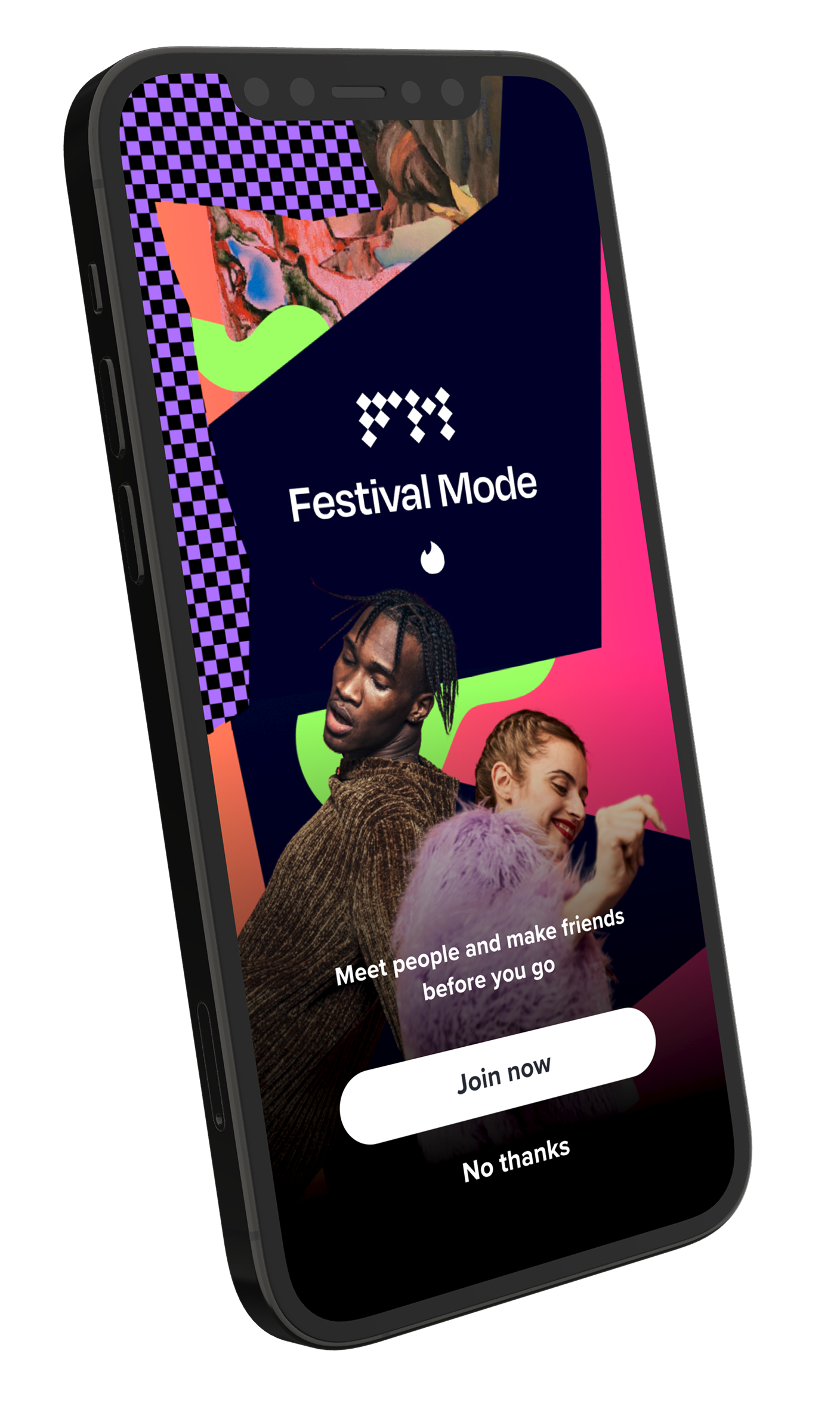
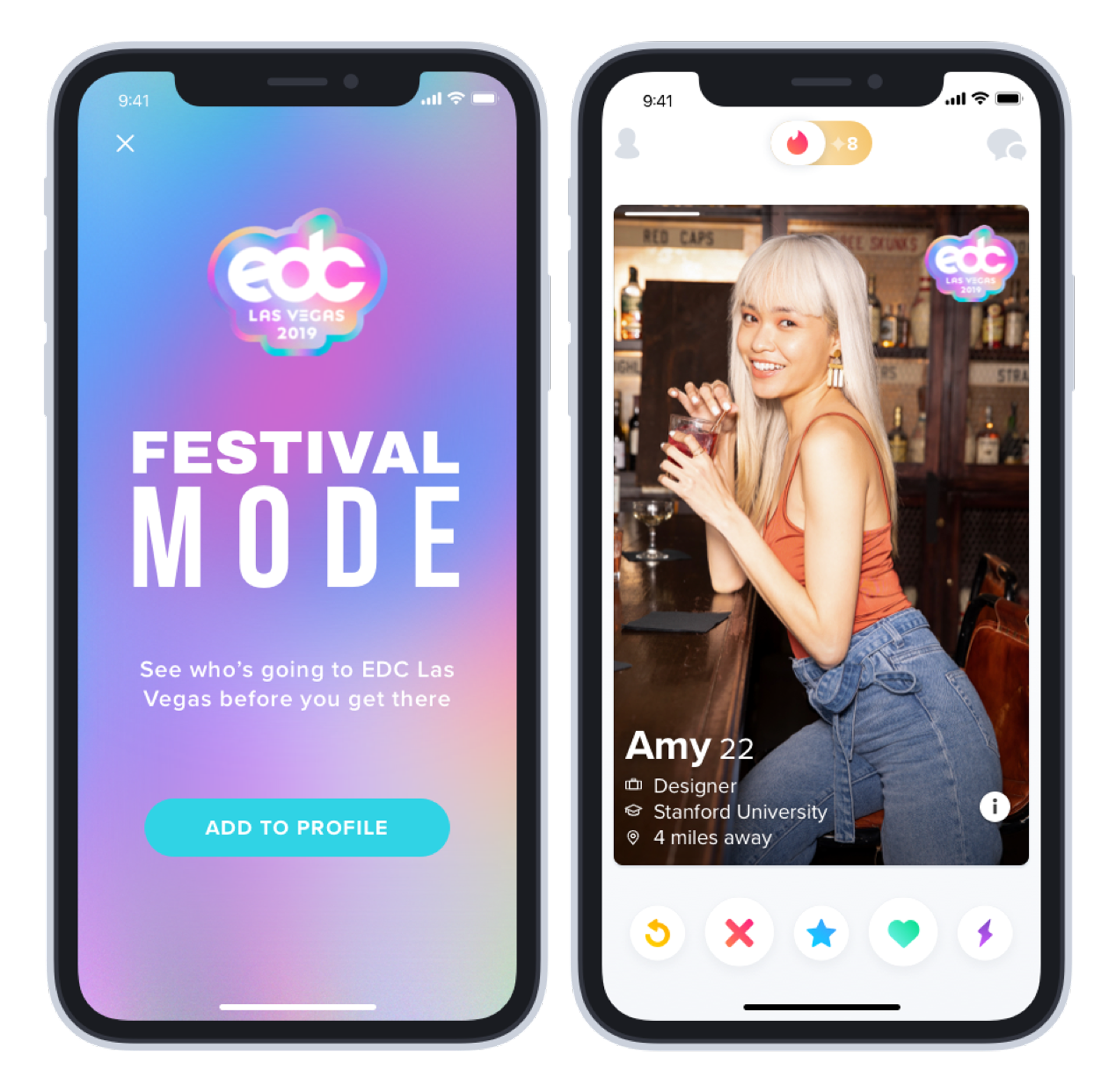
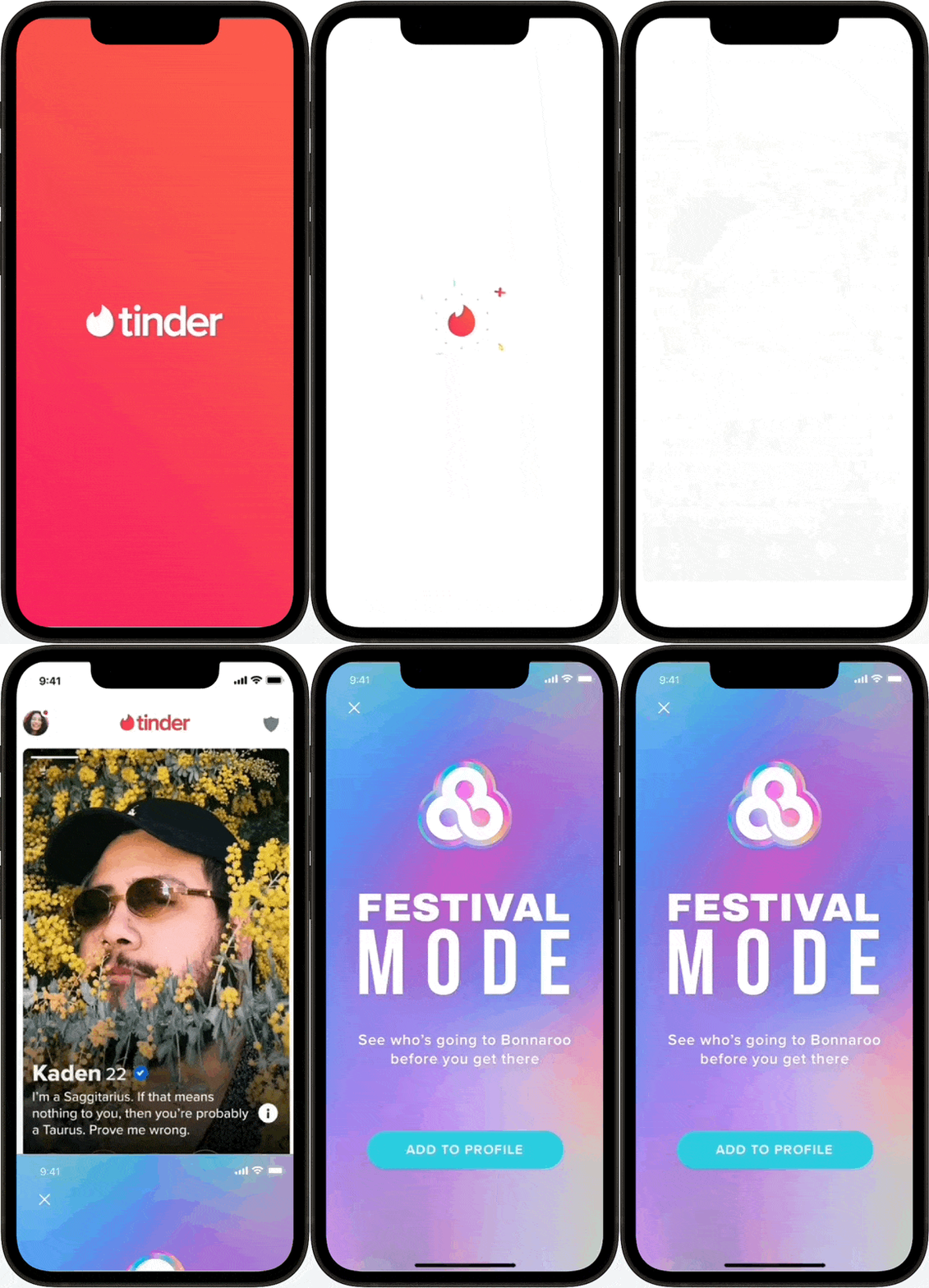
Festival Mode first launched in 2019: a single-festival entry that let users opt in to swipe on people going to the same event. It got pulled when festivals were cancelled during the pandemic. With IRL events returning in 2022, Tinder wanted to bring it back and refresh it for the way the app had evolved.
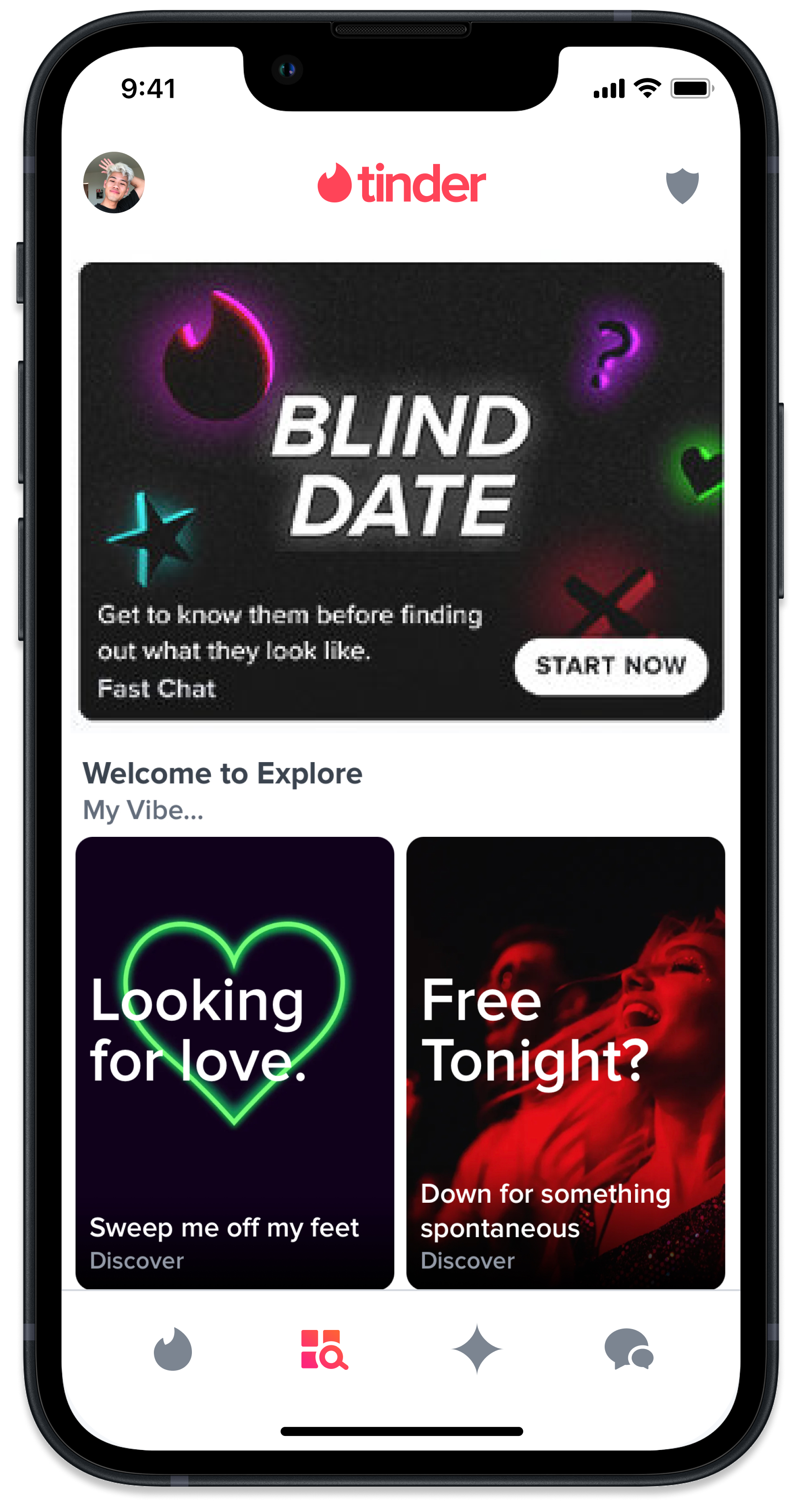
And where it would live: Explore
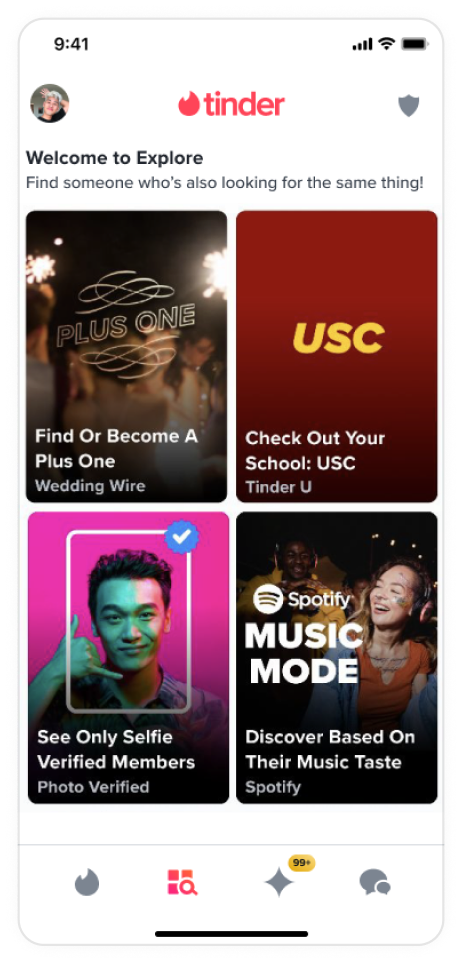
Explore was a new tab in Tinder built around focused ways to connect. Instead of one global cardstack, users could pick from themed categories like Looking for Friends or Coffee Date, or jump into chat games and alternate swipe modes when they wanted a break from the main deck. The relaunched Festival Mode would live there, as a curated experience for festivalgoers.
Why not just relaunch the 2019 version?
The 2019 version had real limitations, mostly because it didn’t have a permanent home in the app.
Limitation 1
One-time entry point
Could only run one festival at a time, which capped partnership opportunities (limited flexibility). And once users hit the entry, they had to decide right then if they were interested. The opt-out was hidden (forced decisions).
Limitation 2
Lack of curation
Positioning on the main page meant no way to guarantee you’d only see people from your festival.
Why Explore was the right home
Explore had the traffic, but engagement was thin. Concept testing showed users got overwhelmed by content that felt too general. A purpose-built Festival Mode tile could give the page the specificity it was missing.
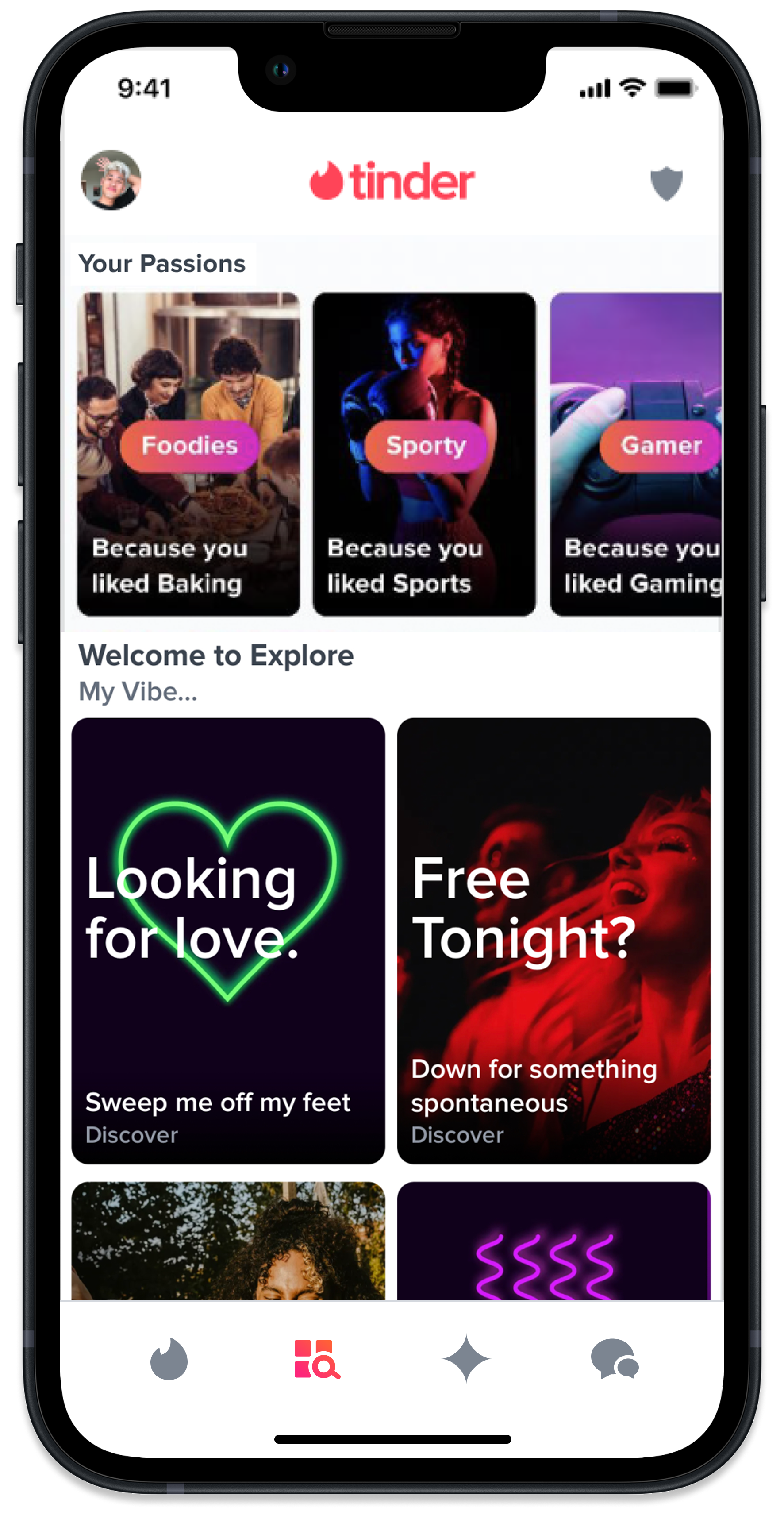
90%
Of active Tinder users visit Explore.
25%
Of those visitors have opened an experience tile.
20%
Of tile-openers go on to open a second one.

Business Goal
Introduce a persistent entry point in Explore to drive Explore engagement.

Partner Goal
Deliver this solution ahead of festival dates to ensure success with festival partners.

Success Metrics
- Explore tile opens
- Likes sent
- Conversations started
Who are festivalgoers?
Consumer research and user interviews told us that festivalgoers go to multiple events per year, are open to going alone, and use apps for both social and event discovery.
2 to 3
Festivals a year for the average festivalgoer.
5 to 6
Festivals a year for the most serious festivalgoers.
56%
Would go alone if they really wanted to attend.
Target demographic
- 18 to 35 year olds.
- Living in the US, UK, Spain, Norway, Germany, France, the Netherlands, and Australia.
- EDM, R&B, country, and mixed-genre music fans.
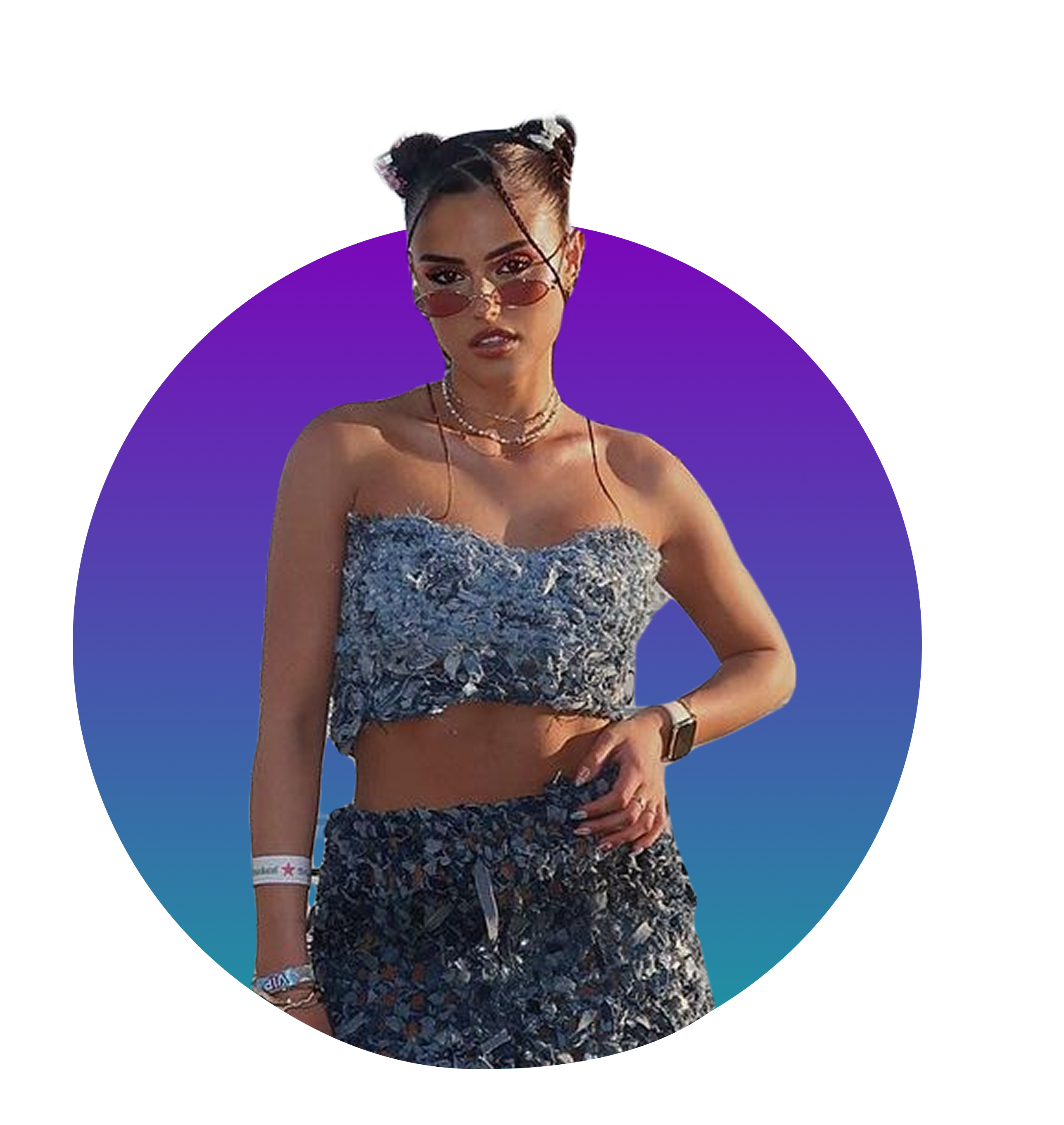
Meet Jen, our persona
To keep the team aligned, we built a persona around the shared patterns we saw in interviews.
Jen , 25
-
 Single
 -
 Marketing Associate
 -
 Bachelor's Degree
 -
 Lives in Los Angeles
Behaviors
- Excited for festival season, planning to go to several this year.
- Prefers company, but open to going solo if there’s no one to go with.
- Uses apps for event discovery and making new connections.
Frustrations
- Tough to find people to go with: friends aren’t ready to return to festivals yet.
- Existing apps aren’t helpful for connecting with people pre-event.
- Hard to form lasting connections at festivals due to event chaos.
Goal
Connect with other festival enthusiasts, find people to go with, and meet up pre-festival to avoid event chaos.
What other apps were doing
We looked at apps Jen-like users mentioned to understand what was already out there and where the gap was.

Eventbrite
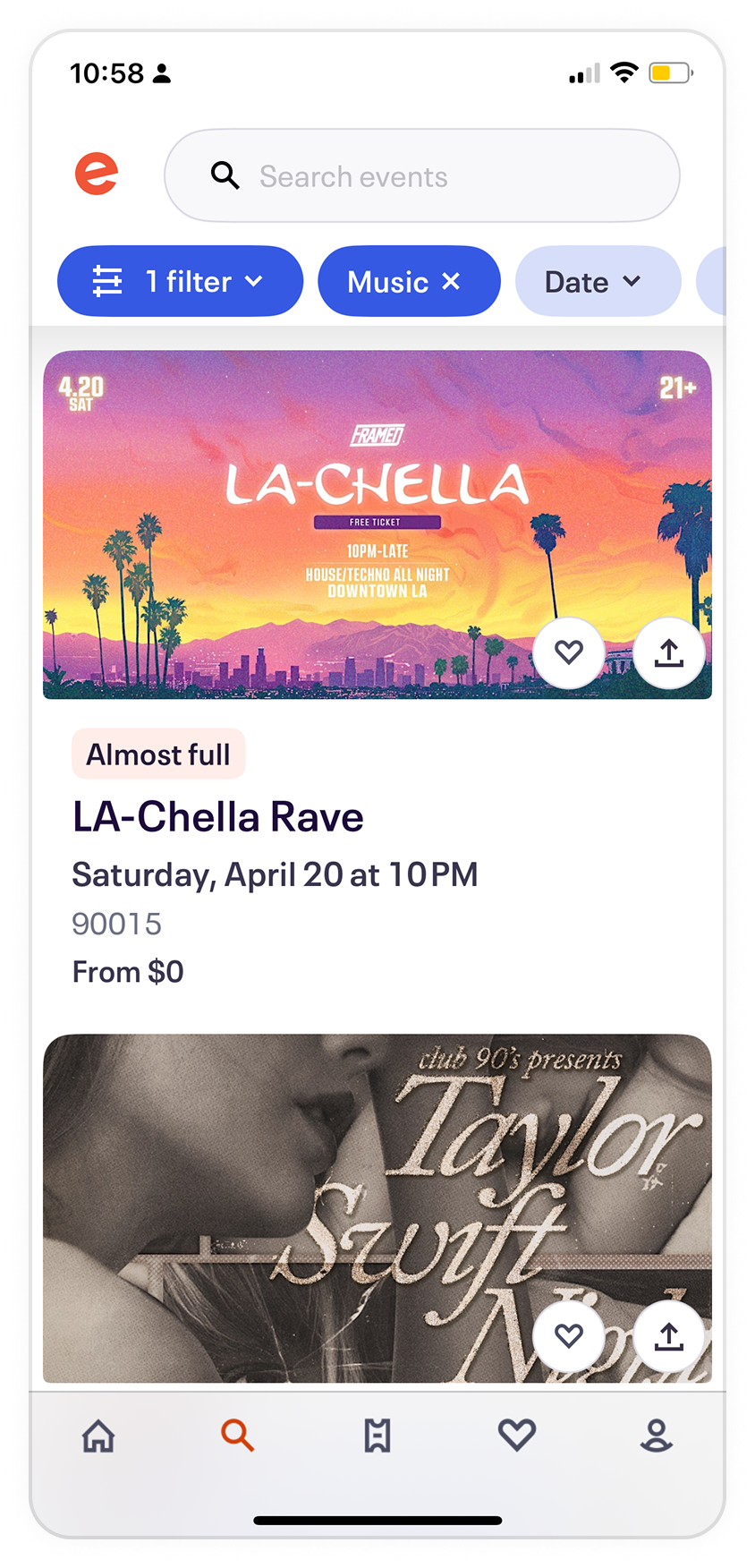
- Robust filtering and sorting for events
- Mainly used for event discovery
- No social features

Meetup
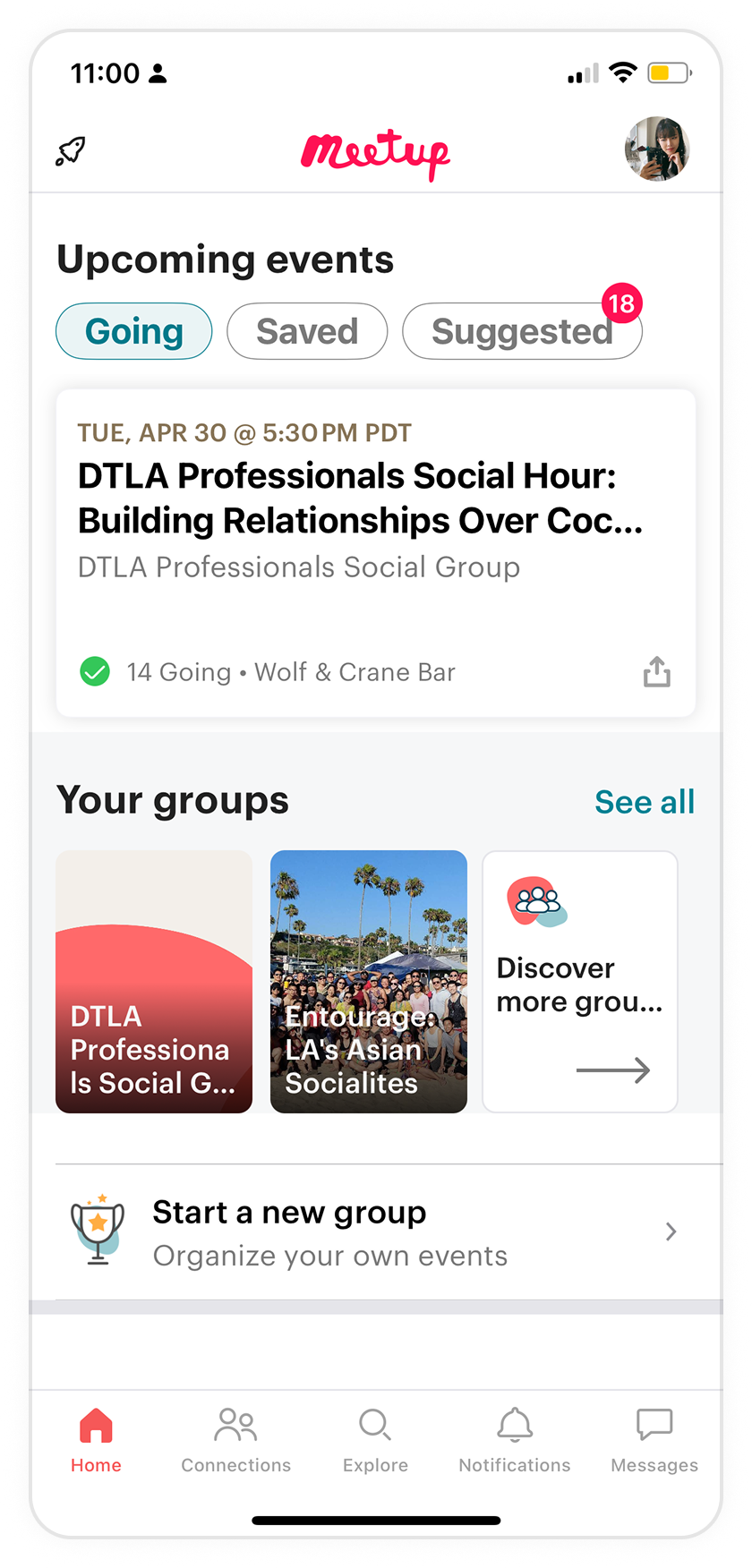
- Groups and events enable IRL connections
- No way to connect before a meetup
Radiate
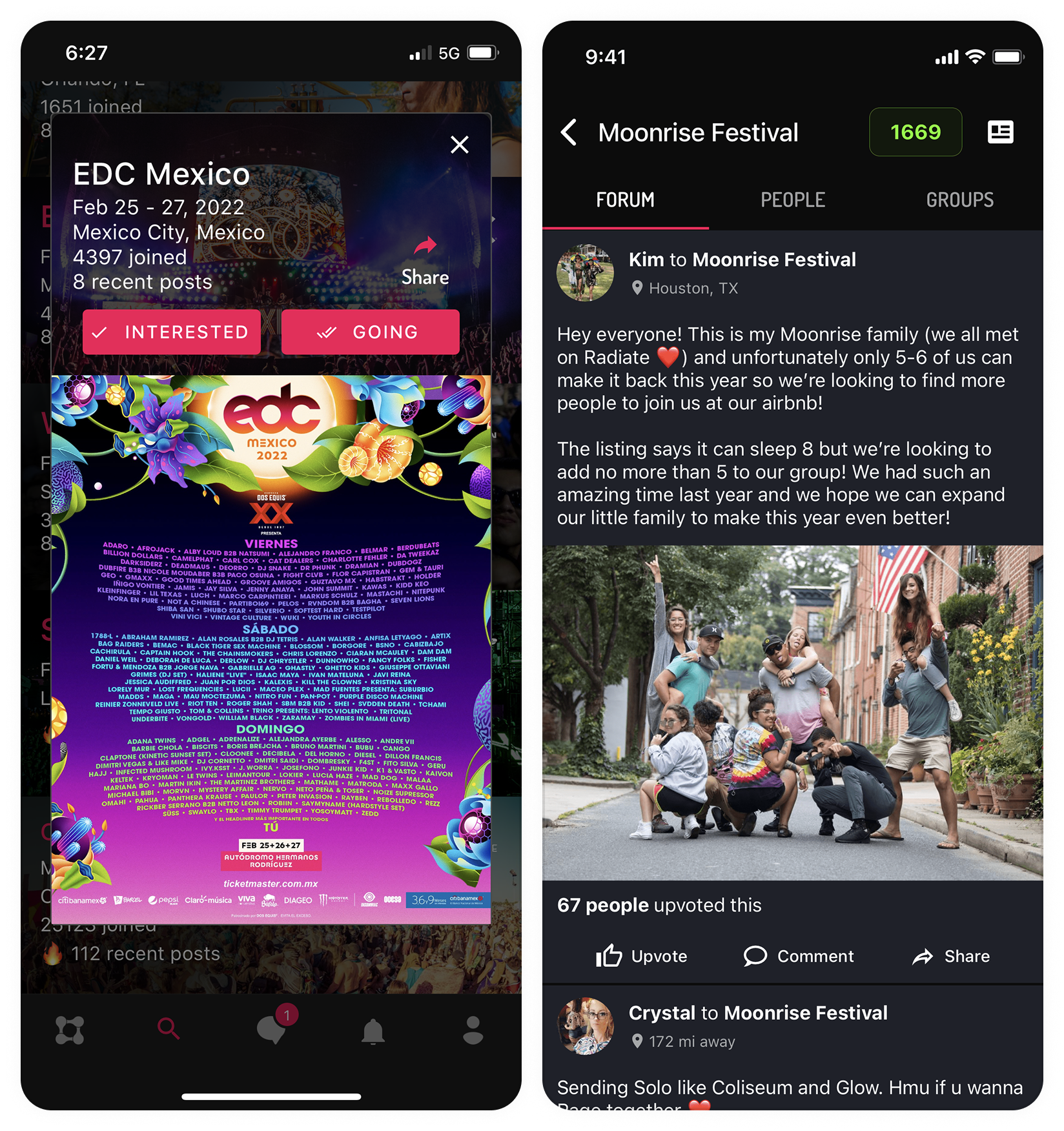
- Can RSVP “Going” or “Interested” to unlock event page
- Forum-style, not conducive to 1:1 connections
Revisiting goals as How-Might-We's
We reframed each stakeholder’s goal as a How-Might-We to focus exploration.
User
How might we help festivalgoers like Jen find others across multiple shared festivals of interest?
Business
How might we leverage Explore as an entry point to drive more traffic and engagement?
Partners
How might we help each festival stand out while staying true to partner brands?
Picking a layout for the Explore entry
With the HMWs as guardrails, we ran a multivariate test against six candidate layouts for the Explore entry. Swipe through to see each variant and how it performed.
-
Carousel
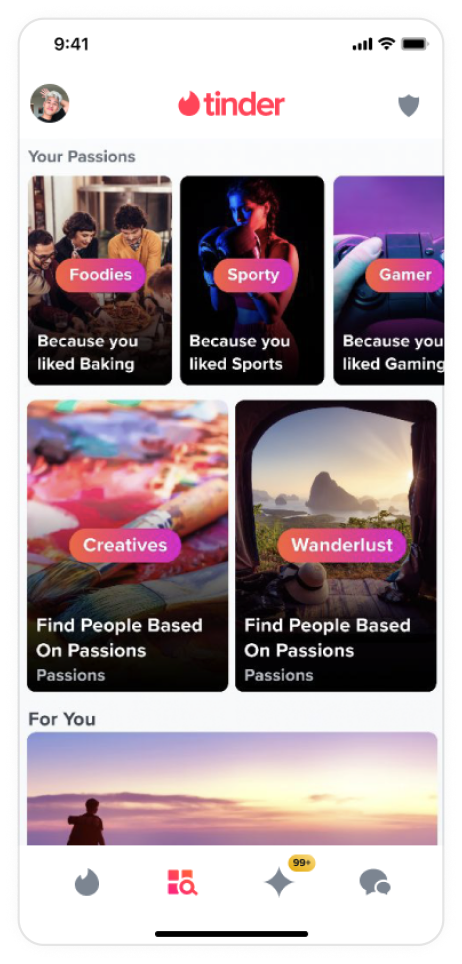
- Swipes Sent
- Tile opens
-
2x8 Grid
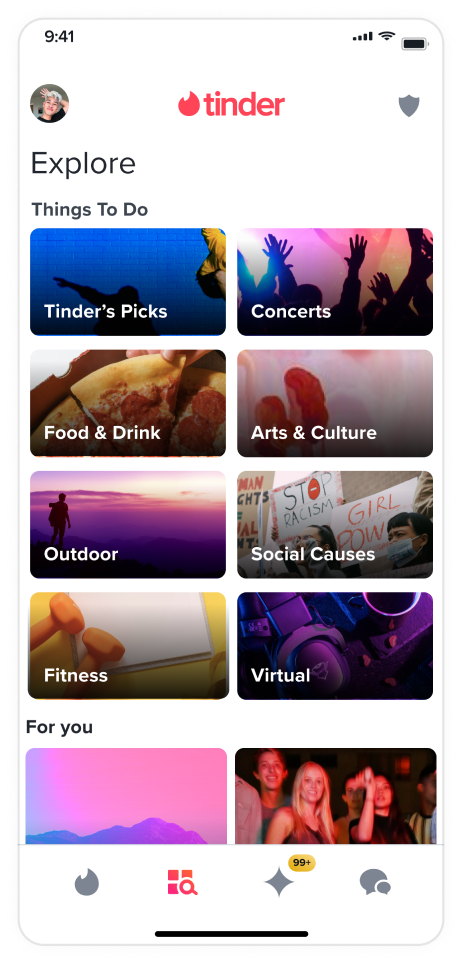
- Swipes Sent
- Tile opens
-
Hero Tile
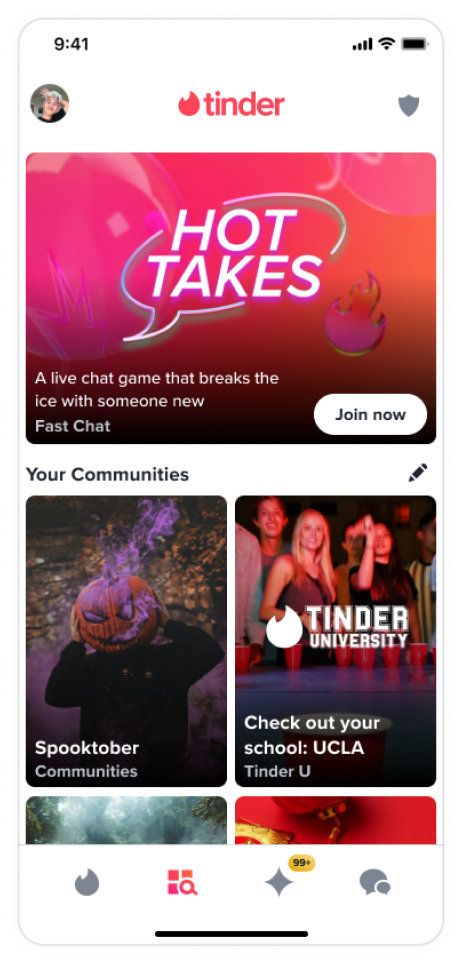
- Swipes Sent
- Tile opens
-
Horizontal Ticker
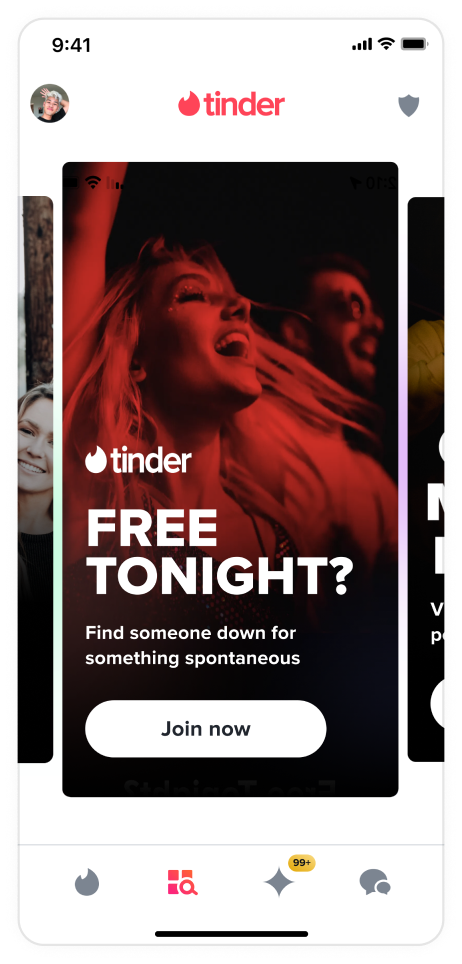
- Swipes Sent
- Tile opens
*Part of broader Explore testing
-
Vertical Scroll
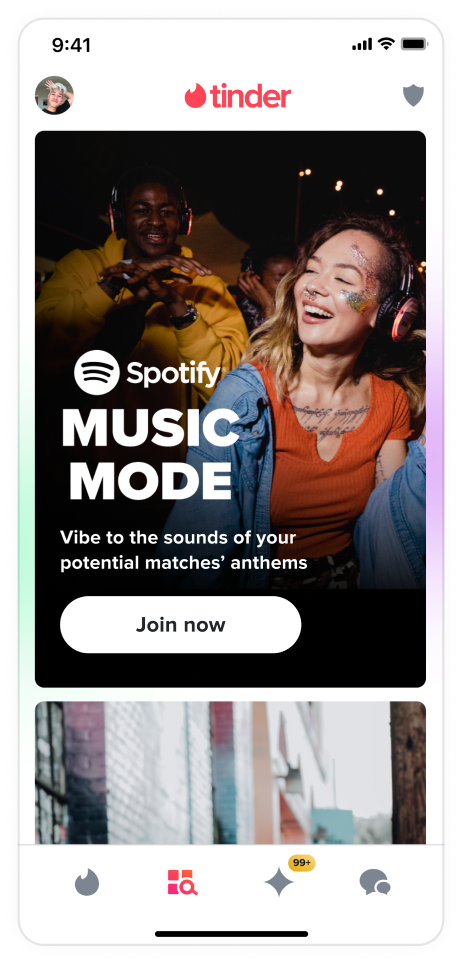
- Swipes Sent
- Tile opens
*Part of broader Explore testing
-
Vertical Tiles
- Swipes Sent
- Tile opens
Narrowing the MVP
Two months meant ruthless scoping. After early reviews with engineers, we deferred richer features (RSVPs, event-specific prompts) to future milestones. The MVP scope landed on three things.
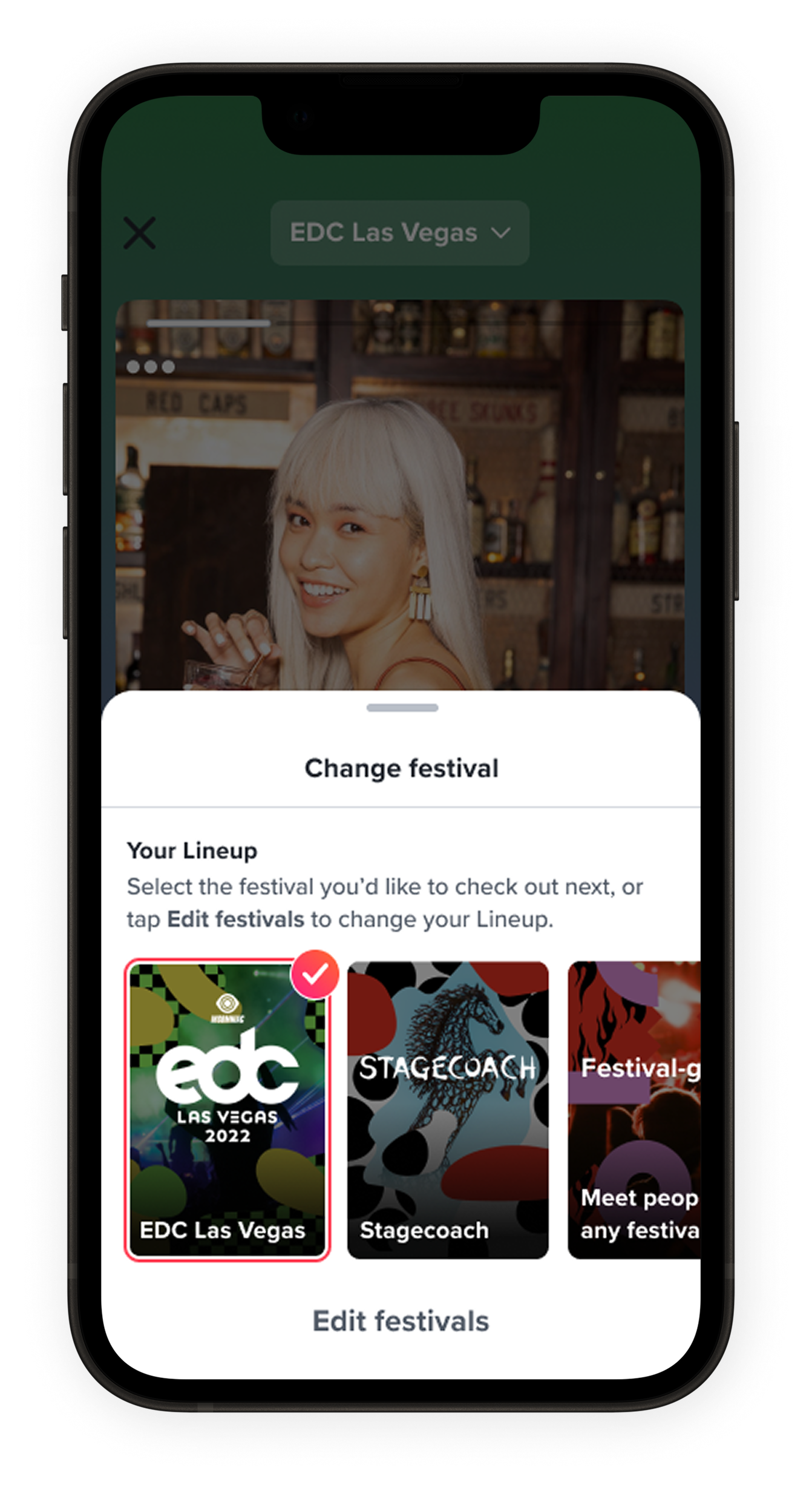
Multiple festival support
The core differentiator from 2019. I focused most of my UX work here.
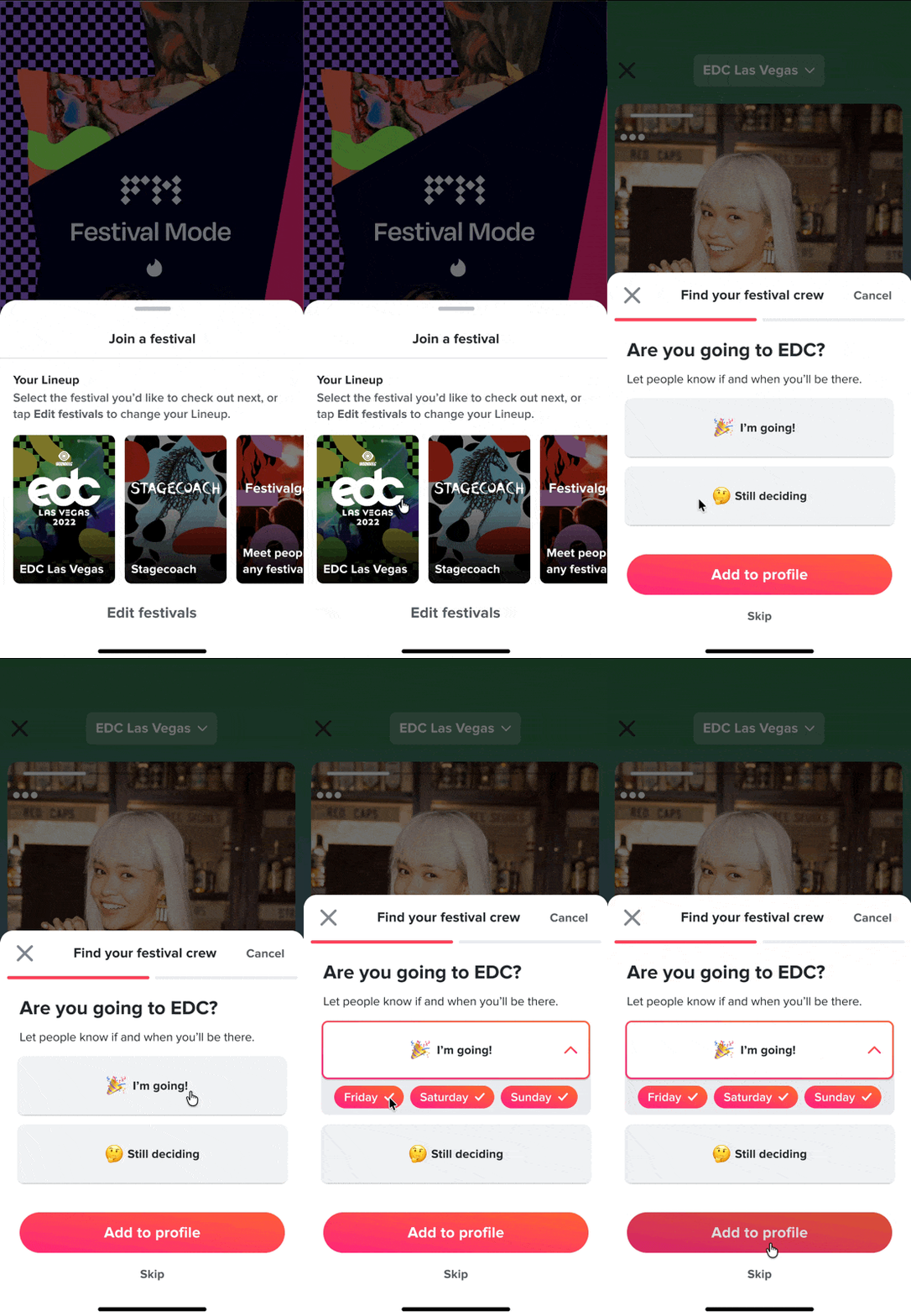
Opt in and out
Users can change their mind any time. Opt-out is no longer hidden.
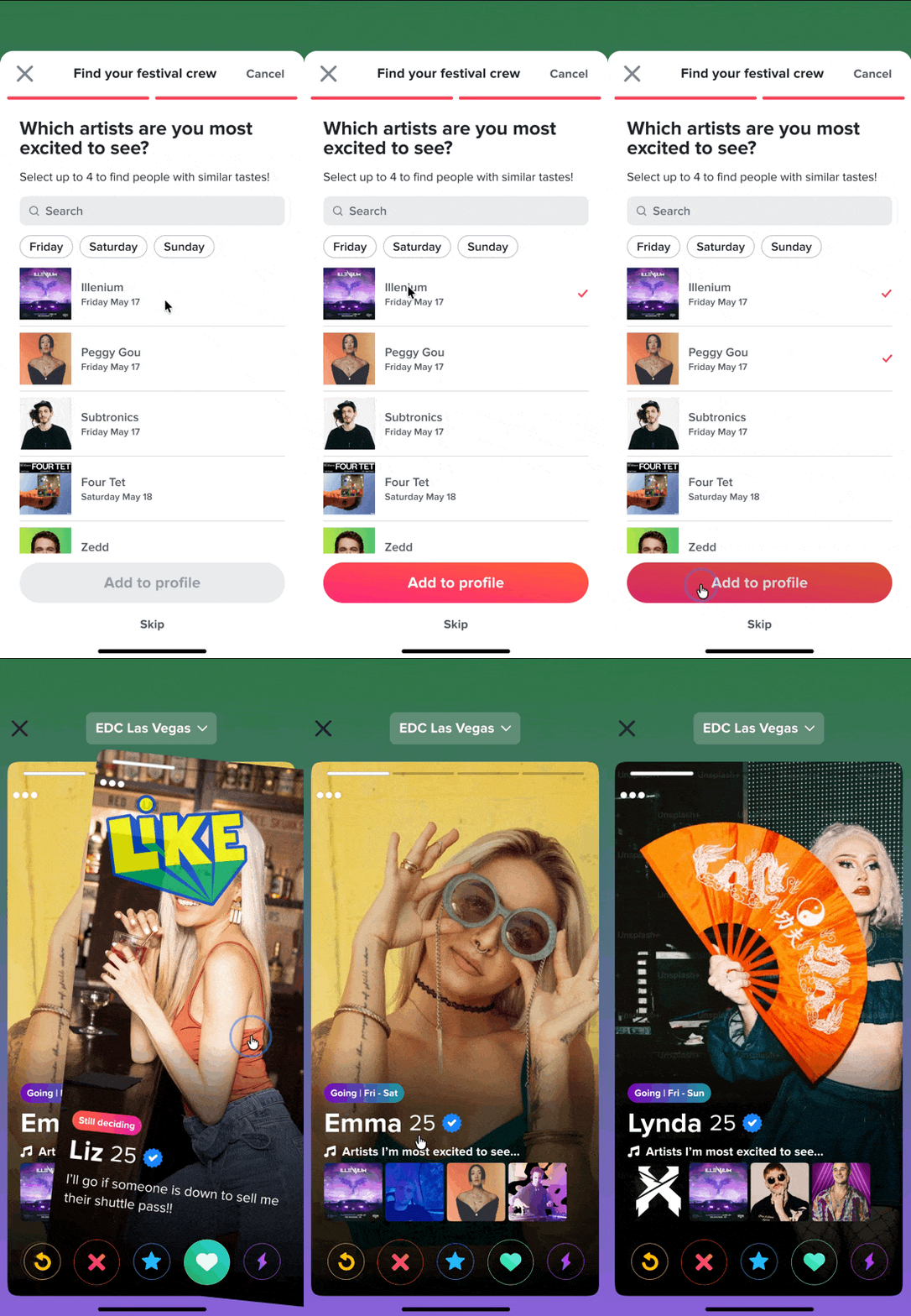
Festival-curated swiping
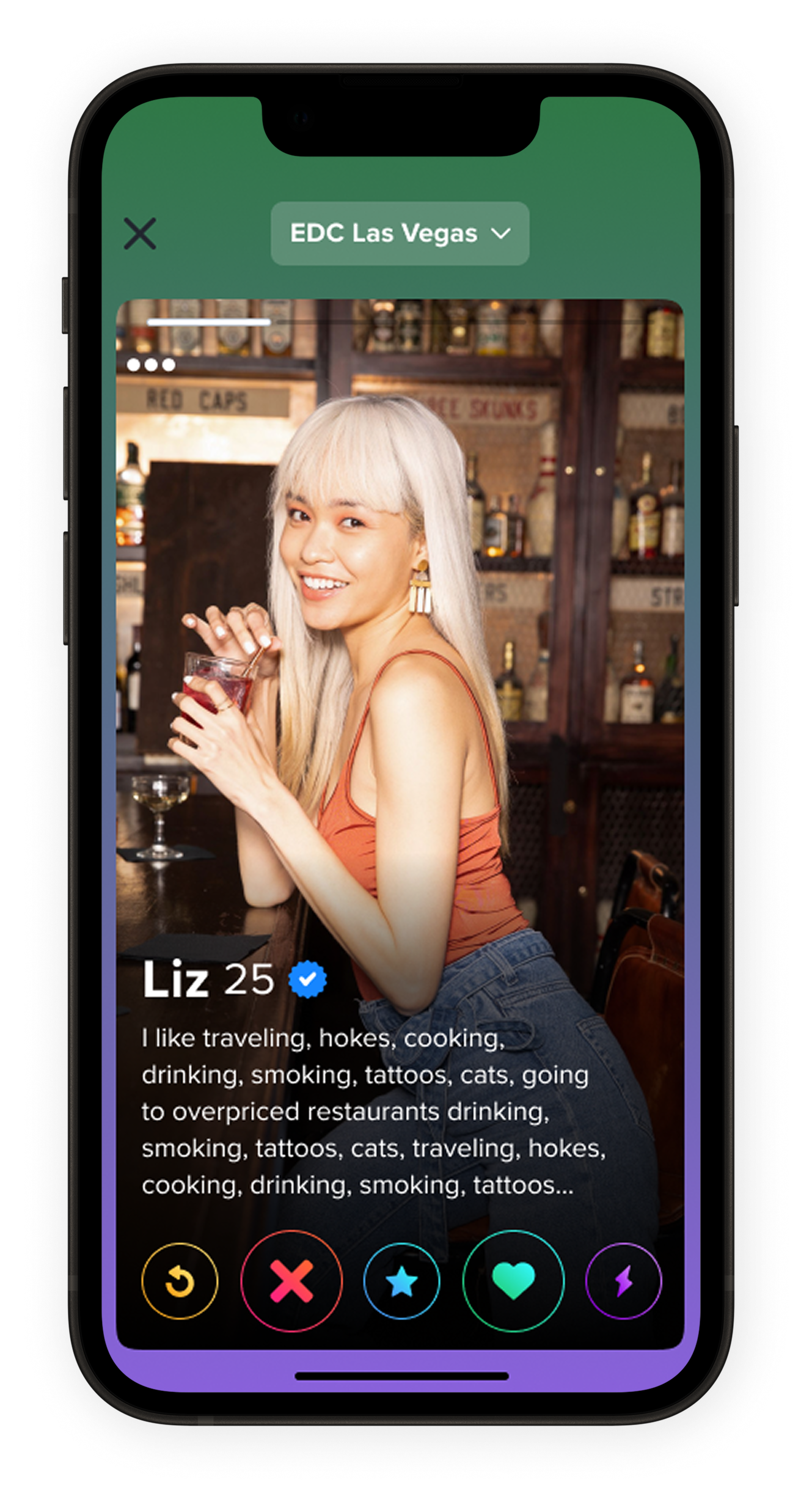
See and swipe on profiles who have also opted in to a festival.
Single-select or multi-select?
The biggest open UX question was whether festivalgoers should pick one festival or multiple. We had two hypotheses.
- H1. Multi-select preferred, since many haven’t decided on a single festival yet.
- H2. Festivalgoers may want richer features (cross-festival messaging, etc.), but are okay with using messaging to accomplish the same in MVP.
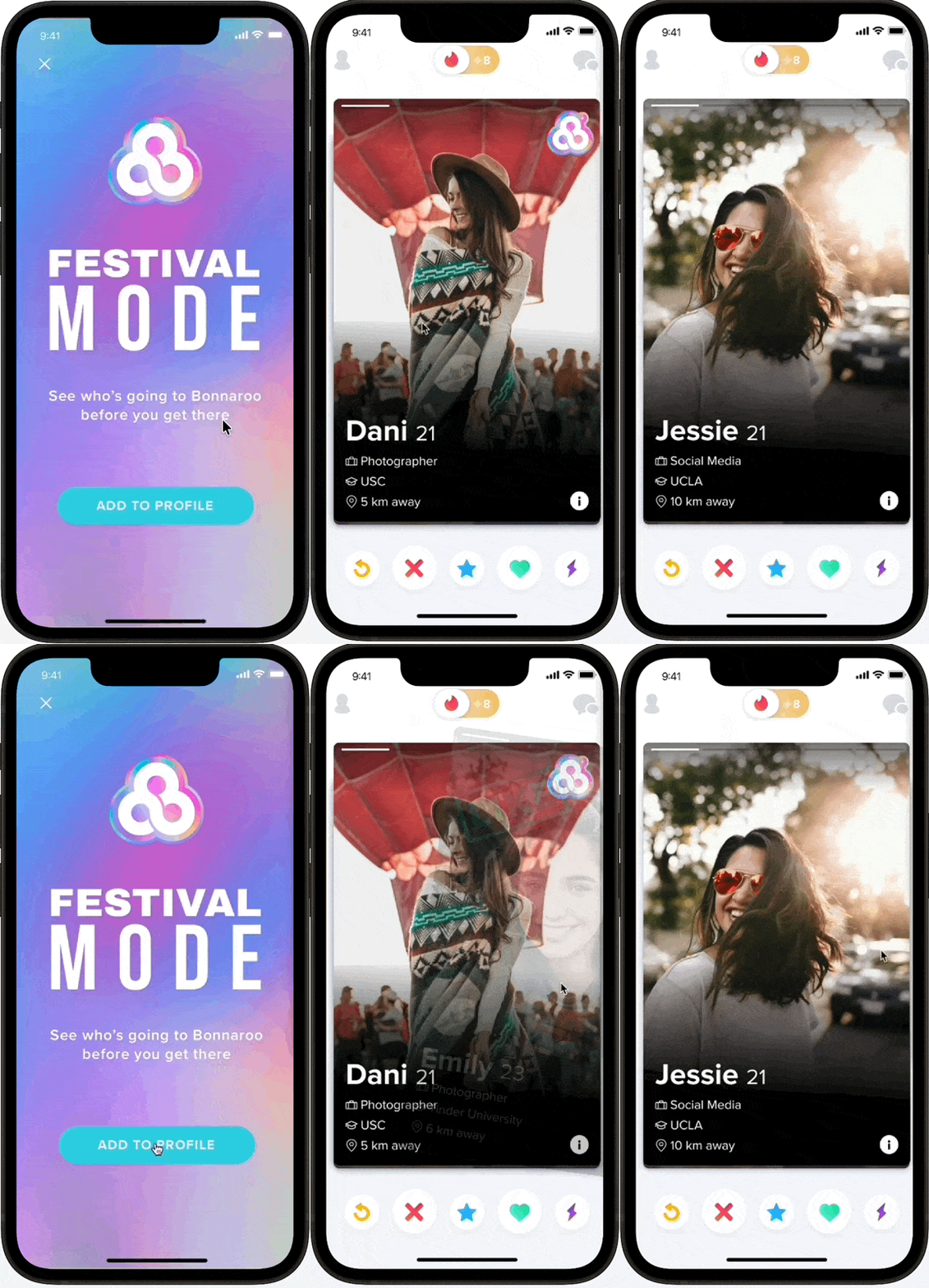
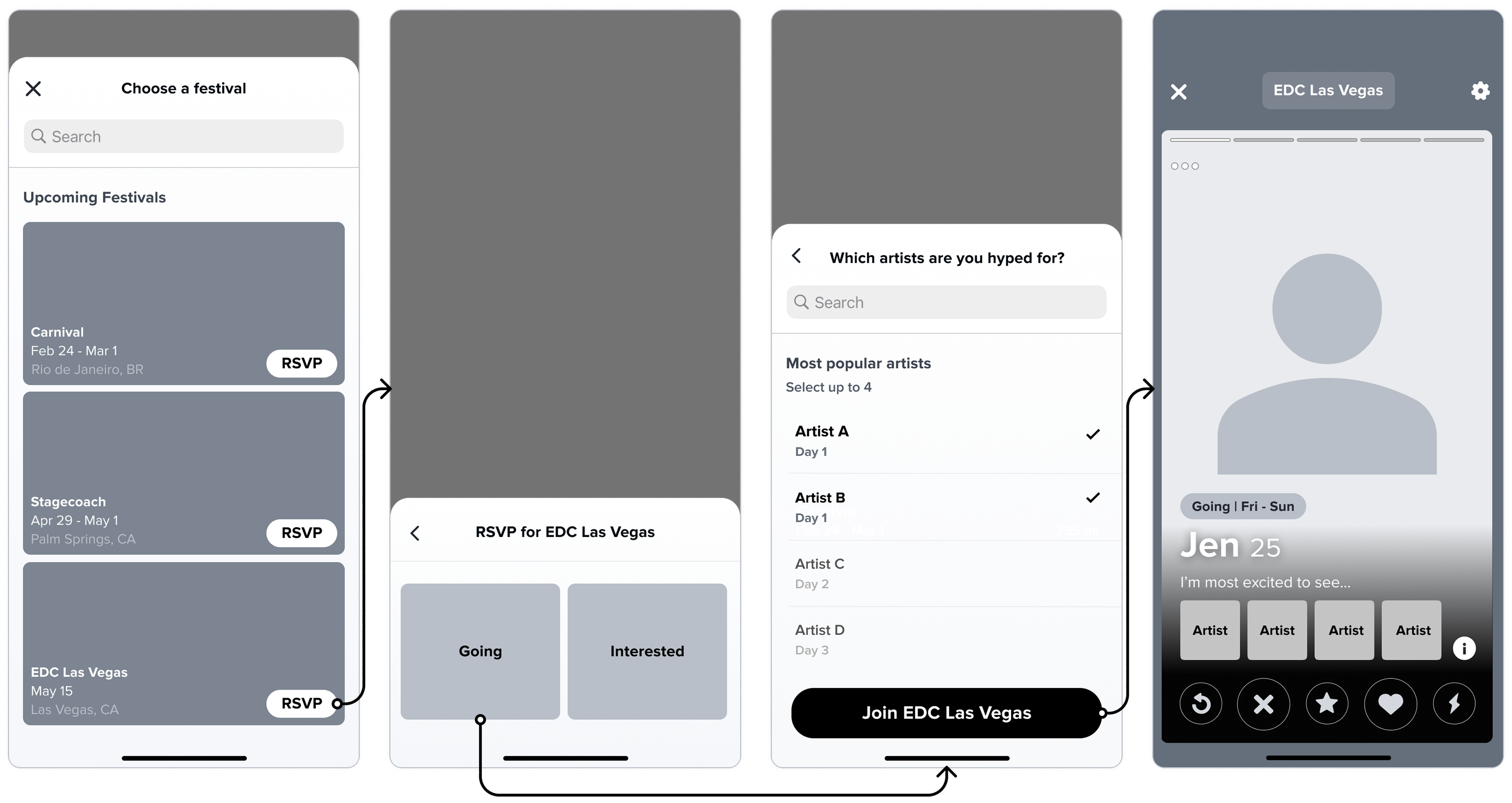
We tested two flows: single-select with separate cardstacks per festival, versus multi-select with one mixed cardstack.
Flow 1: Single-select, separate cardstacks
Flow 2: Multi-select, one mixed cardstack
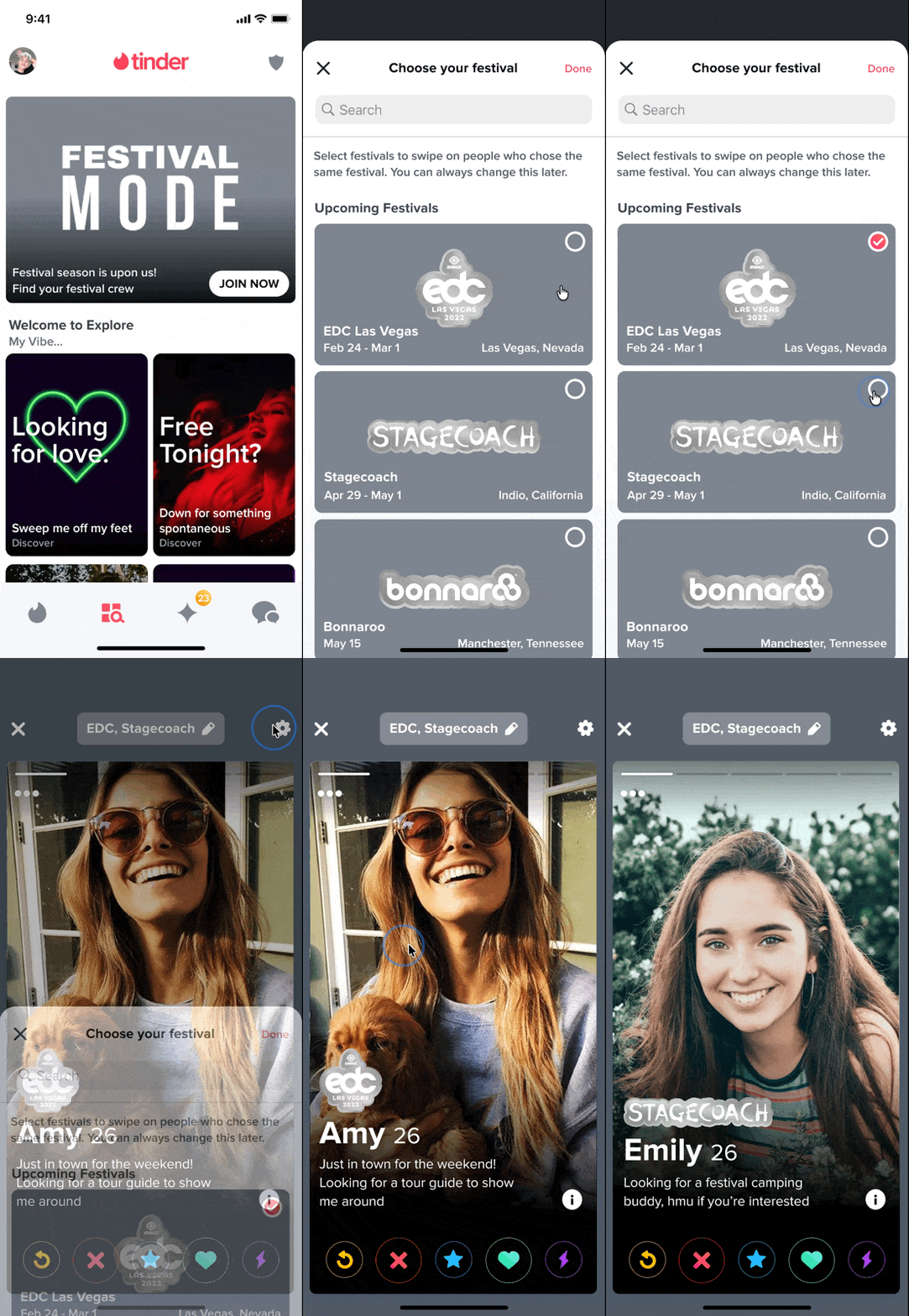
UXR Results
The MVP met festivalgoers’ needs. Across 12 participants:
- 10 of 12 said they’d use it. All described it as intuitive and easy to use.
- Multi-select preferred for opt-in flexibility, since most hadn’t decided on a single festival yet.
- Separated stacks felt more organized during the actual swiping. The single mixed stack led to incorrect swipes because users couldn’t tell which festival a person was from.
- Need for catch-all participation. Due to partnership constraints, some users didn’t see their festival listed but still wanted to participate.
I like to get to know people a bit before meeting up with them. This feature helps me to do that.
I would 10/10 use this. This would be so helpful in finding people to go with.
The combination flow
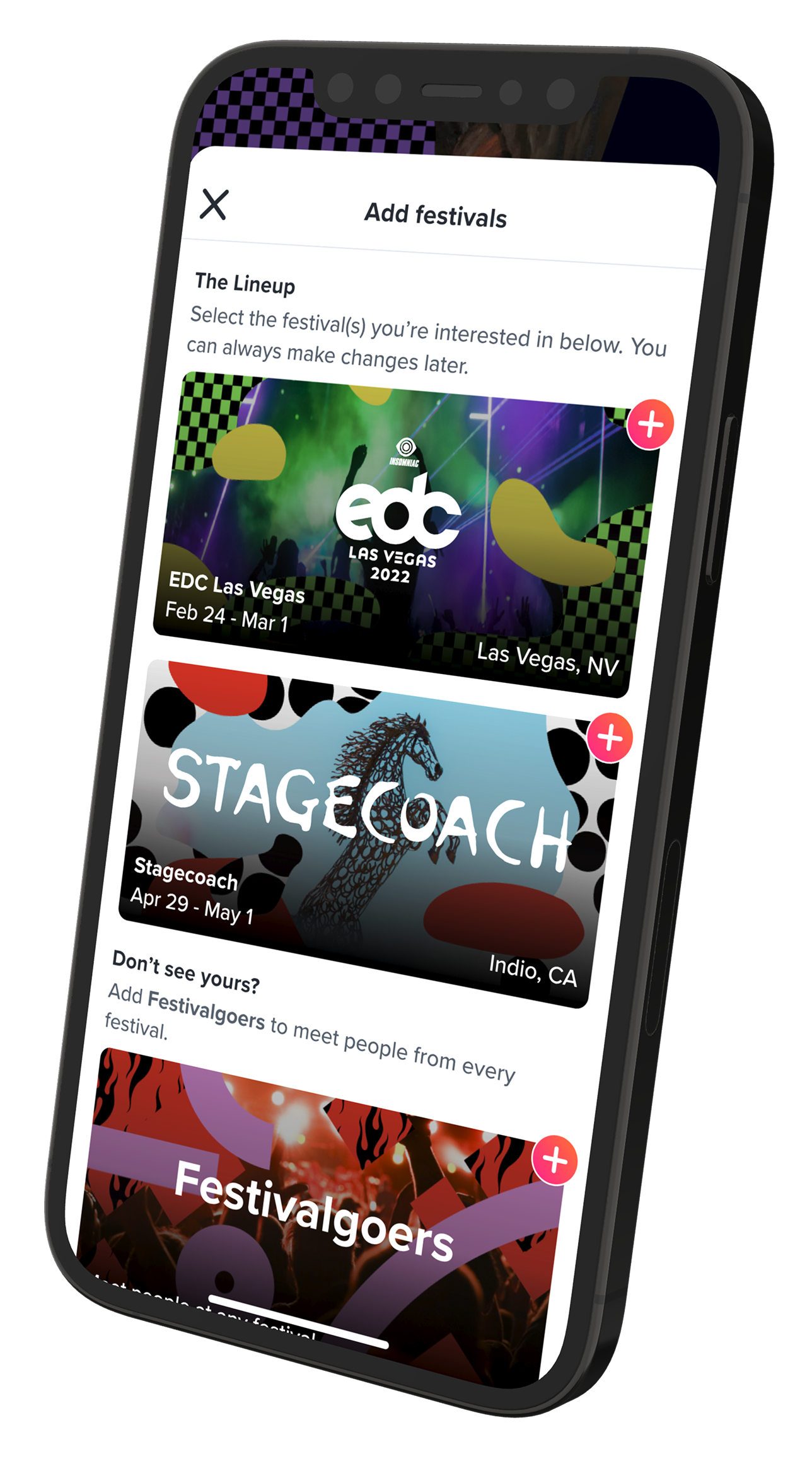
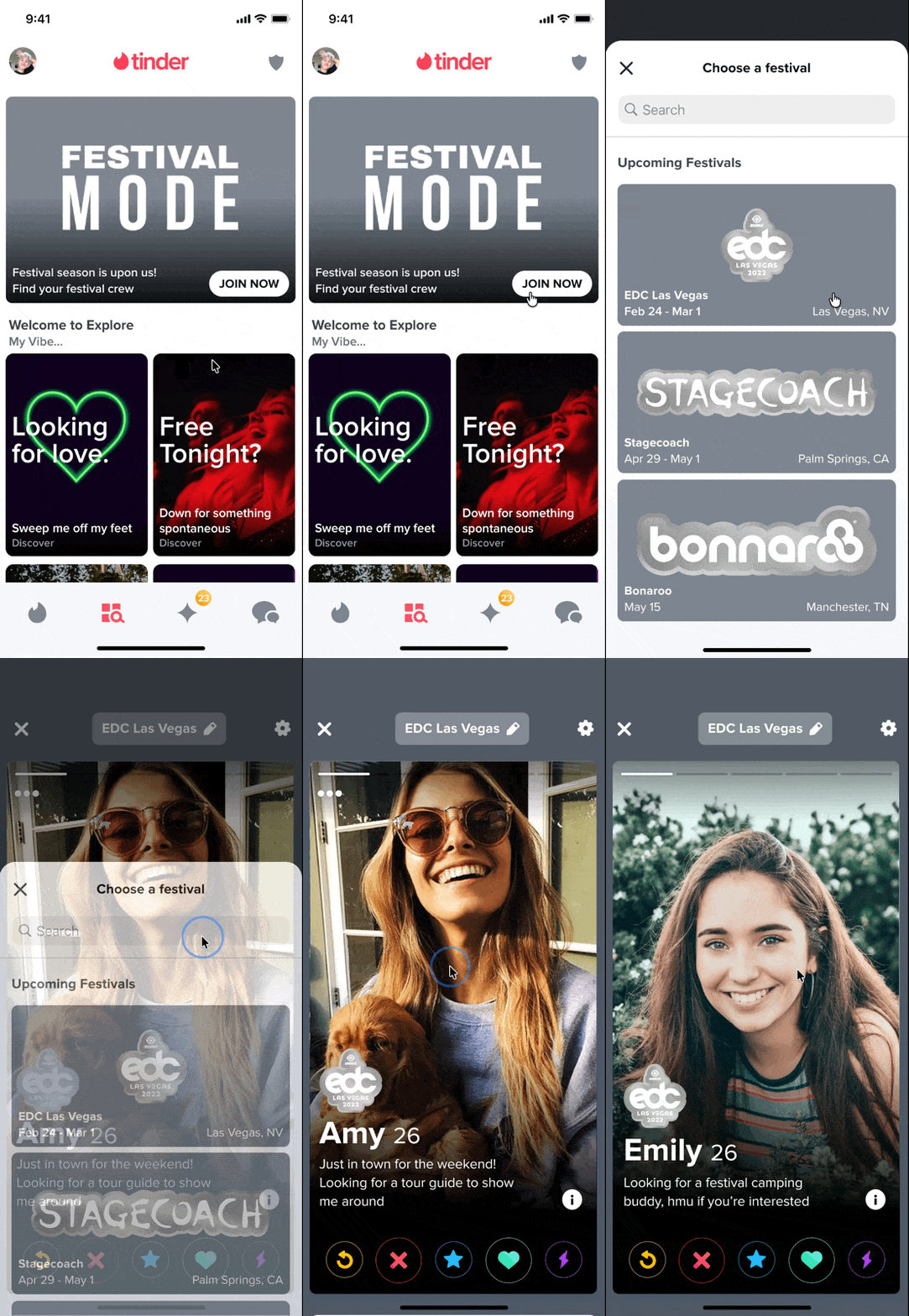
Neither flow won outright, so I made the call to combine the strongest parts of each: the opt-in pattern from Flow 2, the swiping pattern from Flow 1, plus a generic tile to solve the catch-all problem.
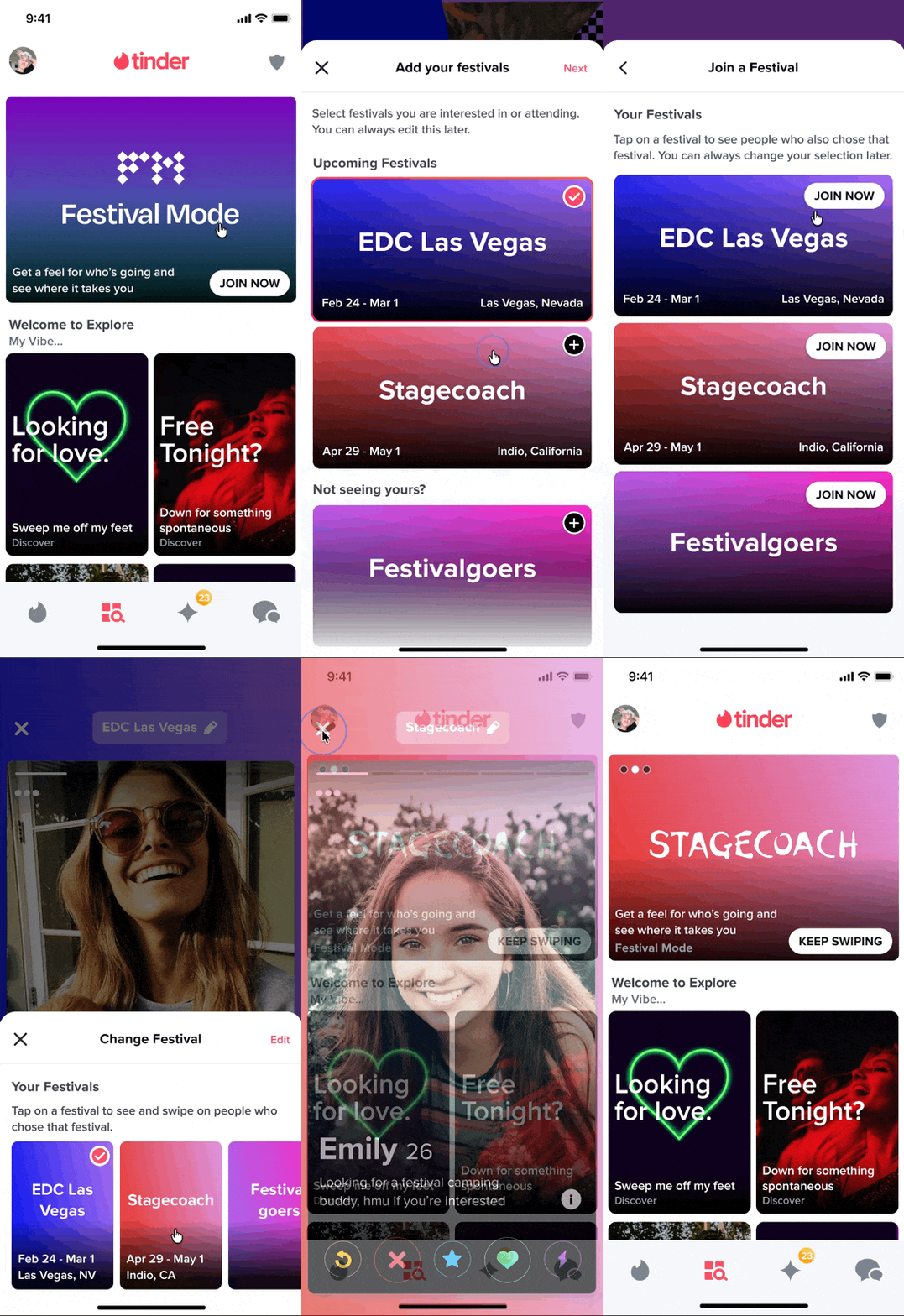
Multi-select during opt-in
Lets users pick more than one festival up front, since most hadn’t decided on just one.
Separated cardstacks
Clearer delineation while swiping. No mixed-festival confusion or incorrect swipes.
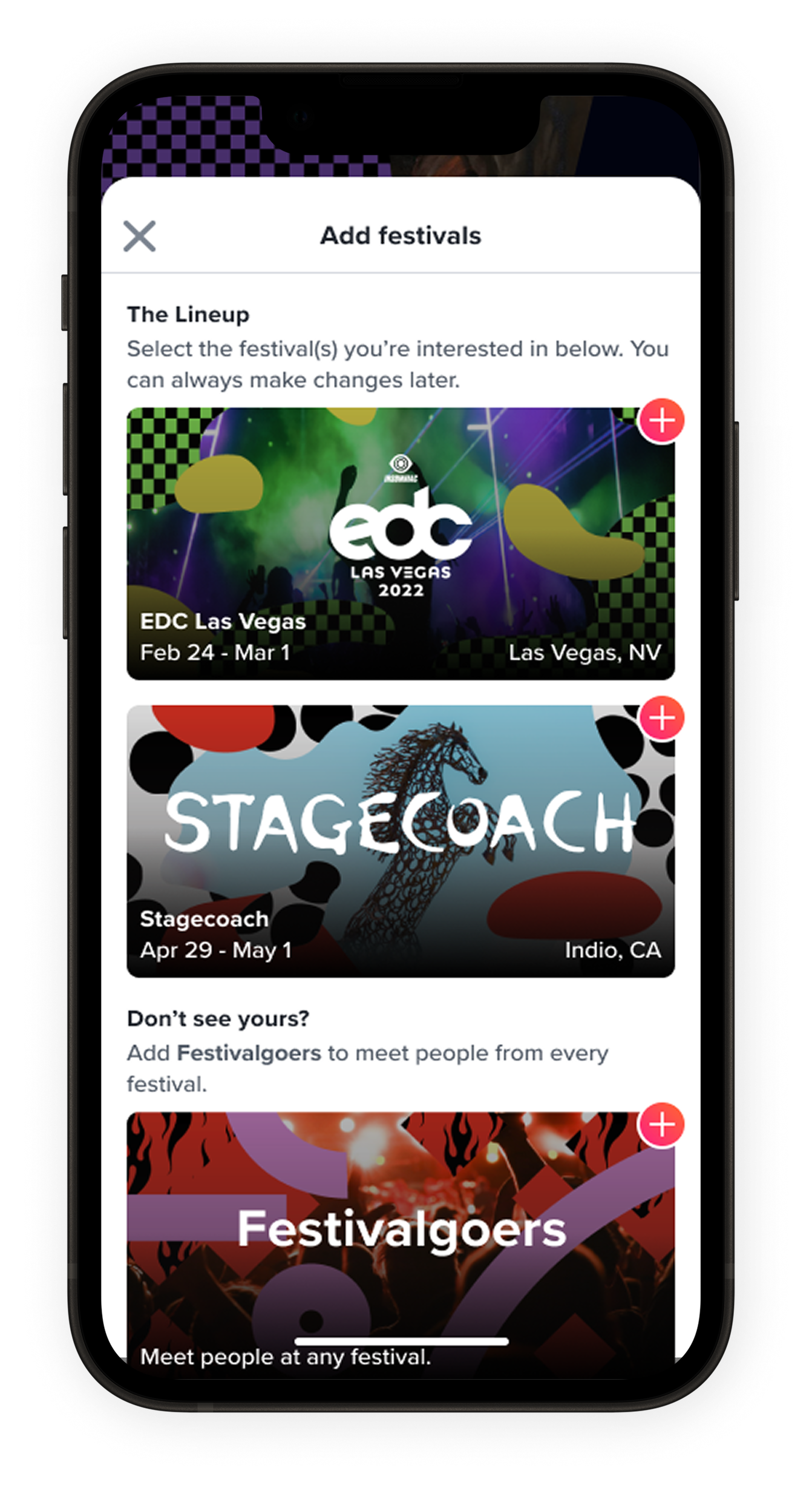
Generic "Festivalgoers" tile
People whose festival isn’t listed can still participate and meet other festivalgoers.
Users were more engaged in Festival Mode than they were in the main Tinder experience. The generic Festivalgoers tile meaningfully expanded the audience without diluting the core experience. Each festival got its own visual treatment, branded with the marketing team and built from existing design system patterns, so partners felt distinct without a custom build per event.
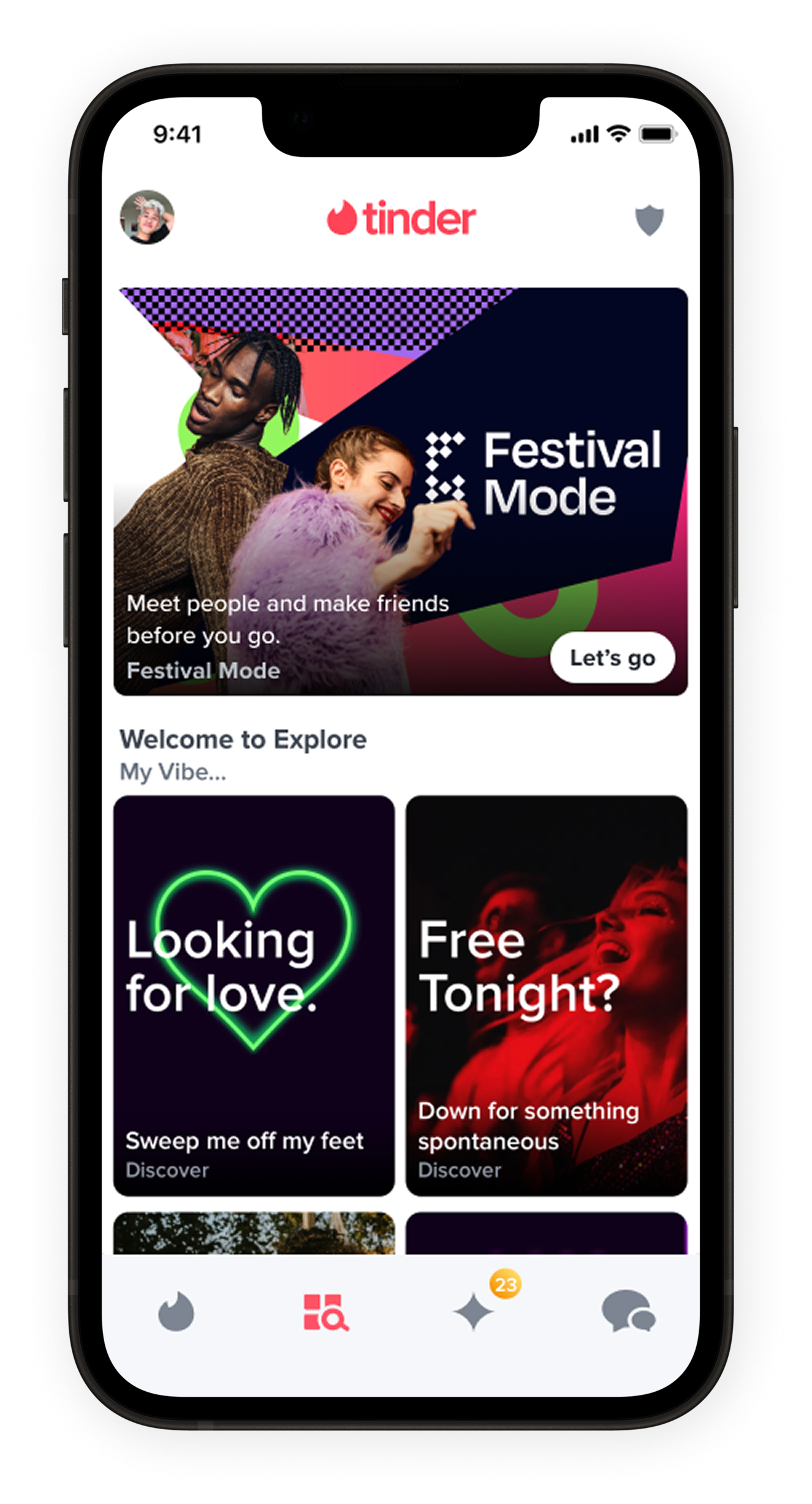
2×
More likes sent and conversations started in Festival Mode vs. the main Tinder experience, especially among women.
↑ 10%
Increase in tile opens on Explore, driven by the generic Festivalgoers tile capturing users whose festival wasn't listed.
💡
Opt-in friction filtered out low-intent users. Those who did opt in were higher intent and more engaged.
Future milestones
What I'd carry forward
The biggest lesson was that opt-in friction is a feature, not a bug, when the goal is purposeful connection. The biggest thing I’d do over: kill the second opt-in step. We saw the drop-off in the data and I’d push harder next time to fold festival selection into the first tap.